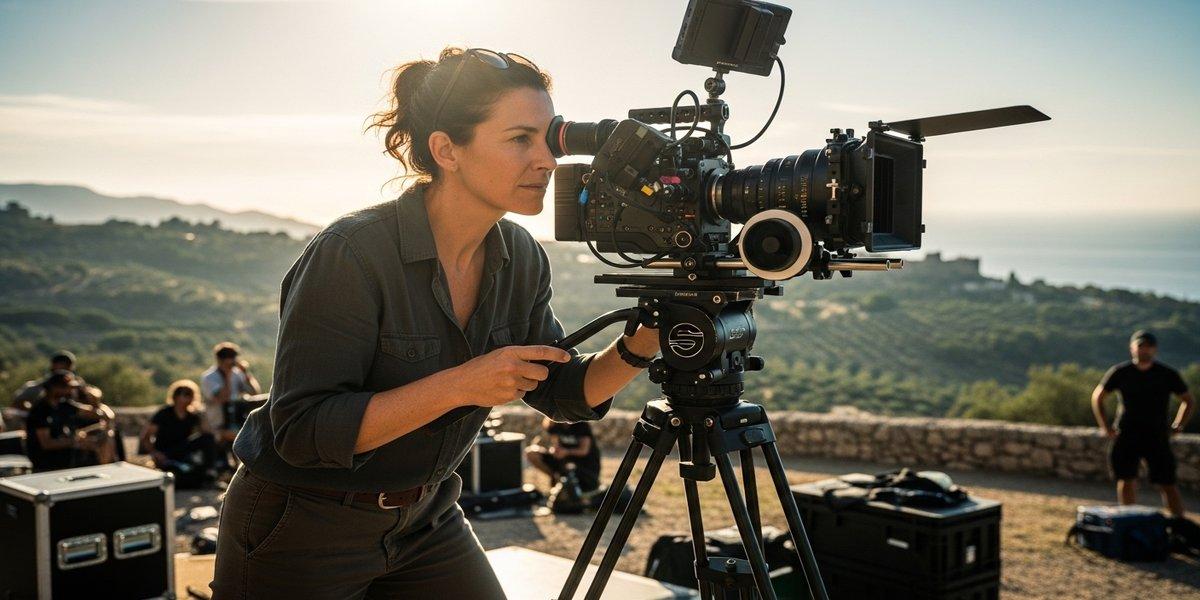
Mediterranean cinema has long been a conversation dominated by male voices — the Chahines and Ceylans, the Sorrentinos and Kiarostamis. But in the past two decades, a generation of women filmmakers — pioneered by voices like Yamina Benguigui — has emerged across the region, making work that is not merely excellent but transformative: reshaping the way their cultures see themselves, their histories, and their futures.
Nadine Labaki (Lebanon)
Nadine Labaki’s Caramel (2007) was a revelation: a film about five Lebanese women navigating love, beauty, and social convention in a Beirut hair salon, directed with a warmth and humor that made it the most commercially successful Lebanese film in history. Her subsequent work — Where Do We Go Now? (2011) and Capernaum (2018, nominated for the Academy Award for Best International Feature) — has deepened her engagement with Lebanese society while expanding her audience to global proportions. Her debut Caramel emerged from the same Beirut that produced Michel Kammoun’s Falafel. Labaki’s gift is making the political personal: Capernaum, about a child suing his parents for the crime of giving him life, transforms the abstraction of poverty into a story that is impossible to look away from.
Maryam Touzani (Morocco)
Maryam Touzani’s debut feature, Adam (2019), tells the story of a pregnant unmarried woman taken in by a Casablanca bakery owner — a scenario that, in Morocco, carries implications that a European audience might not fully grasp. Her second film, The Blue Caftan (2022), about a married couple and the young man who disrupts their relationship in a medina workshop, was lauded at Cannes for its delicate handling of sexuality, tradition, and the unspoken agreements that hold Mediterranean societies together. Touzani’s cinema is one of surfaces — fabrics, faces, food — beneath which powerful emotional currents run.
Deniz Gamze Ergüven (Turkey / France)
Born in Ankara and raised in France, Ergüven made one of the most striking debut features of the 2010s: Mustang (2015), about five orphaned sisters in a conservative Turkish village whose increasing confinement by their guardians becomes a metaphor for the restrictions placed on women across the Mediterranean. The film earned an Oscar nomination and established Ergüven as a filmmaker of fierce intelligence and visual flair. Her subsequent Hollywood work (Kings, 2017) was less successful, but Mustang endures as one of the essential Mediterranean films of the twenty-first century.
Yamina Bachir Chouikh (Algeria)
The eldest filmmaker on this list, Bachir Chouikh made her debut feature, Rachida, in 2002 — a film about the Algerian civil war that no male Algerian filmmaker had the courage or the perspective to make. Her focus on women’s experience of conflict — the teachers who kept schools open, the mothers who kept families intact — filled a gap in Algerian cinema that was as much moral as aesthetic. Read our interview with Bachir Chouikh.
Alice Rohrwacher (Italy)
Alice Rohrwacher makes films about the Italian countryside that feel like waking dreams. The Wonders (2014, Grand Prix at Cannes) and Happy as Lazzaro (2018, Best Screenplay at Cannes) explore the collision between tradition and modernity in rural Italy with a magic realism that owes something to Fellini and something to fairy tales. Her most recent film, La Chimera (2023), about tomb raiders in 1980s Tuscany, confirms her position as one of the most original voices in European cinema.
These five filmmakers share little in terms of style, subject matter, or national context. What they share is a refusal to accept the roles that Mediterranean cinema culture traditionally assigns to women — muse, victim, mother, object — and a determination to tell stories that have not been told before. Their work is the most compelling argument for the vitality of Mediterranean cinema today.