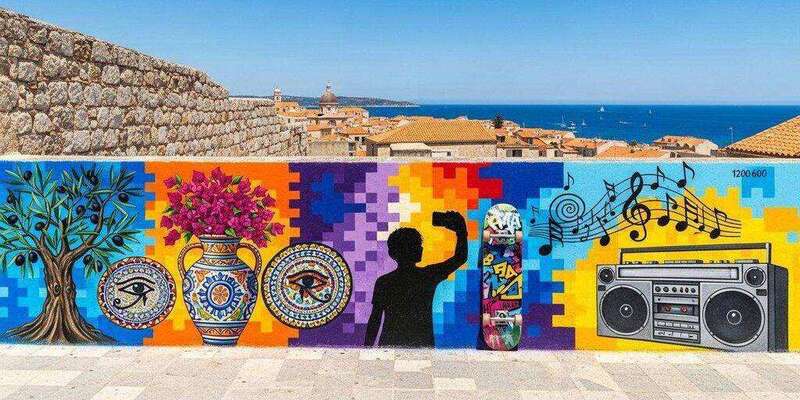
The walls of Mediterranean cities have always spoken. In Pompeii, they carried electoral slogans and obscene graffiti. In the Alhambra, they carried poetry in stucco. In twentieth-century Athens, they carried political slogans — BREAD, EDUCATION, FREEDOM — painted by partisans and protesters on surfaces that the state considered its own. The tradition of the speaking wall is as old as the Mediterranean itself.
Today, that tradition continues in the form of street art — murals, stencils, paste-ups, and interventions that transform urban surfaces into galleries, manifestos, and memorials. Across the region, street artists are using the built environment as a canvas for commentary on politics, identity, migration, and the specific pressures of life in cities that are simultaneously ancient and collapsing under the weight of modernity.
Beirut: Art on Bullet Holes
In Beirut, street art occupies a unique position: it operates on walls that still carry the scars of the civil war (1975–1990) and the 2006 Israeli bombardment. Artists like Yazan Halwani — known for his large-scale portraits of Lebanese cultural icons — paint directly onto bullet-pocked facades, using the physical damage as both texture and context. The result is a palimpsest of violence and beauty that is impossible to encounter without confronting the city’s history.
Athens: The Anarchist Aesthetic
The Exarcheia neighborhood of Athens — traditionally a center of anarchist and left-wing culture, and the same district where the rebetiko revival found its first audiences — has become one of the most densely painted urban spaces in Europe. The financial crisis of 2010 and the subsequent austerity measures turned the entire city into a canvas for political expression, but Exarcheia’s walls carry the most concentrated and artistically ambitious work. Political slogans coexist with elaborate murals; stencil art quotes Cavafy alongside references to contemporary Greek politics.
Tunis: After the Revolution
The Tunisian revolution of 2011 unleashed a flood of artistic expression that had been suppressed under the Ben Ali regime. Street art — illegal under the dictatorship — became one of the most visible forms of the new freedom. Artists like eL Seed, who works in a calligraphic style that transforms Arabic script into monumental abstract compositions, have gained international recognition while maintaining deep roots in Tunisian visual culture.
Palermo: Migration and Memory
In Palermo, Sicily — a city that has been receiving migrants from across the Mediterranean for three millennia — street art has become a medium for negotiating the latest chapter of that long history. The Ballarò neighborhood, home to one of Europe’s most diverse populations, features work by local and international artists addressing themes of arrival, displacement, and the difficult work of building community across cultural lines.
The Wall as Commons
What distinguishes Mediterranean street art from its Northern European and American counterparts is not style but context. In cities where public space is contested — by governments, by developers, by sectarian groups, by economic crisis — the act of painting a wall is inherently political. It asserts that the city belongs to its inhabitants, not to its rulers; that beauty is a right, not a privilege — a conviction that Predrag Matvejević expressed in literary terms — and that the most important conversations in a society often happen not in parliament or on television, but on the surfaces that everyone sees and nobody owns.