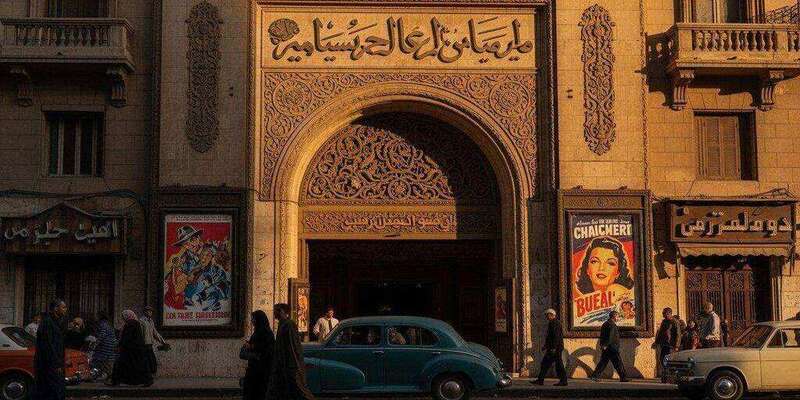
Cairo has been called the Hollywood of the East, and the comparison is more apt than either city might admit. Like Hollywood, Cairo built an industrial-scale film industry on the back of a domestic audience hungry for stories told in its own language and idiom. Like Hollywood, it exported its products across an entire linguistic region — from Morocco to Iraq, Egyptian films and television series have defined the Arabic-language entertainment landscape for the better part of a century. And like Hollywood, its golden age has given way to a more fragmented, uncertain present.
The Golden Age: 1940s–1960s
Egyptian cinema’s golden age coincides roughly with the era of Gamal Abdel Nasser and the heady early years of pan-Arab nationalism. Studios like Misr (founded in 1935 by the industrialist Talaat Harb) and later the state-owned General Egyptian Cinema Organization produced hundreds of films per year — melodramas, musicals, comedies — that created a shared popular culture across the Arab world.
The stars of this era — Faten Hamama, Omar Sharif (before Hollywood claimed him), Soad Hosny, Abdel Halim Hafez — were household names from Casablanca to Baghdad. The films themselves ranged from glossy studio entertainments to serious social dramas, and the best of them — Youssef Chahine’s Cairo Station (1958), Salah Abu Seif’s The Tough (1957), Henri Barakat’s The Open Door (1963) — stand alongside the best work of Italian neorealism and French New Wave.
The Chahine Era
Youssef Chahine deserves special mention — not merely because he was Egypt’s greatest filmmaker, but because his career spans nearly the entire history of Egyptian cinema. From Daddy Amin (1950) to Chaos (2007), Chahine made forty films over fifty-seven years, and his evolution mirrors the evolution of Egyptian society: from postcolonial optimism through Nasserist nationalism, Sadat-era opening, and Mubarak-era stagnation to the frustrated energy that would eventually explode in Tahrir Square. Today, independent voices like Ahmed El Attar continue to push Egypt’s cultural boundaries.
Crisis and Renewal
The decline of the Egyptian film industry in the 1980s and 1990s — driven by competition from television, Gulf-funded production, and economic liberalization that gutted the state’s cultural infrastructure — left a vacuum that the twenty-first century is still struggling to fill. But renewal has come, in unexpected forms: the raw energy of Mohamed Diab’s Cairo 678 (2010), the dark comedy of Ibrahim El Batout’s Eye of the Sun (2012), and the international breakthrough of Netflix-era Egyptian content — developments tracked across the Mediterranean festival circuit.
The question facing Egyptian cinema today is the same one facing the country itself: how to honor a magnificent past while building a future that is neither imitation nor reaction. The answer, if it comes, will likely emerge from the same source it always has — from the filmmakers themselves, working in the gap between what the industry allows and what the audience demands.