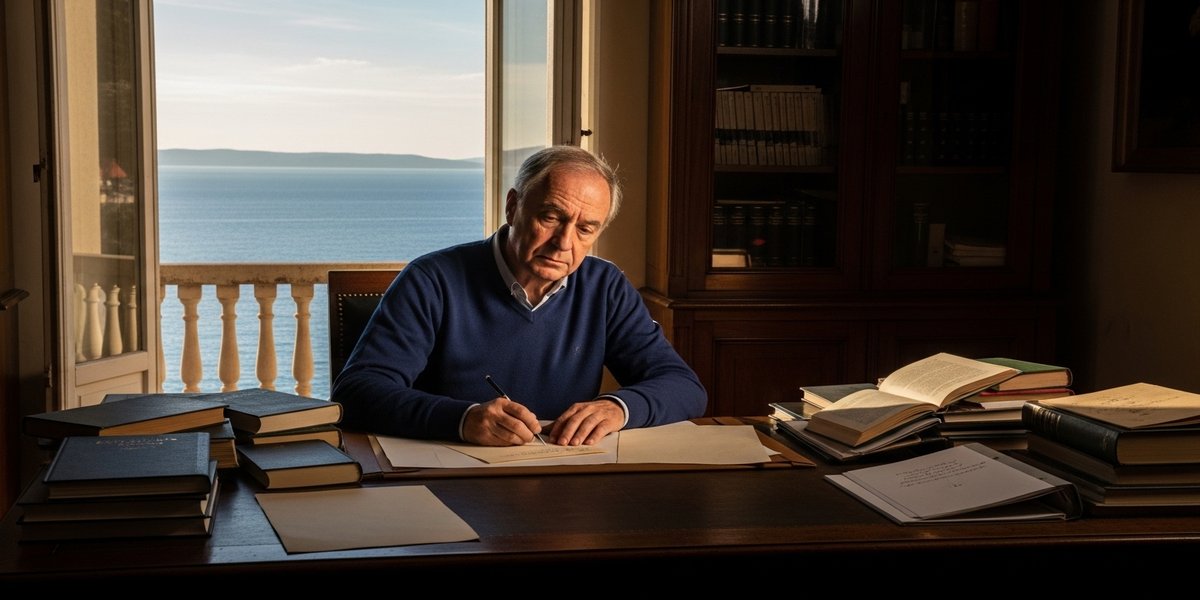
Predrag Matvejević spent his life arguing that the Mediterranean is not a geography but a civilization — and that this civilization is dying of neglect. His masterwork, Mediterranean: A Cultural Landscape (1987), commonly known as the Mediterranean Breviary, is neither a travel book nor a history but something stranger and more ambitious: a taxonomy of the sea itself, cataloguing its ports, its winds, its breads, its walls, its silences.
Born in 1932 in Mostar (then Yugoslavia, now Bosnia and Herzegovina), Matvejević taught at the University of Zagreb before a long exile in Paris and Rome, where he held the chair of Slavic Languages at La Sapienza. A friend of Brodsky, a correspondent of Eco, and a kindred spirit to Amin Maalouf in his insistence on plural identity, he moved through European intellectual life with the ease of someone who belonged to all its traditions and none.
He met EuroMed Café during a conference on the Barcelona Process in 2005, where he was, characteristically, the most skeptical voice in the room.
EuroMed Café: The Barcelona Process proposes a “Euro-Mediterranean Partnership.” You seem unconvinced.
Predrag Matvejević: I am unconvinced by the language. “Partnership” implies equality, but there is no equality between the European Union and the countries of the southern Mediterranean. The north has the money, the institutions, the political power. The south has the people, the history, the problems. This is not a partnership. It is a negotiation — and in every negotiation, the stronger party sets the terms.
EMC: Your Breviary treats the Mediterranean as a single cultural space. Does that vision have political relevance today?
PM: The Mediterranean has always been a space of exchange — goods, languages, genes, ideas, diseases. The Roman mare nostrum was not a border; it was a highway. The problem began when nation-states drew lines across the water and said: this side is Europe, that side is not. The Mediterranean knows nothing of these lines. A fisherman in Sicily and a fisherman in Tunisia have more in common with each other than either has with a bureaucrat in Brussels. My book is an attempt to recover that knowledge before it disappears entirely.
EMC: What is being lost?
PM: The shared vocabulary of Mediterranean life. The way bread is made in every port. The way boats are built. The way olives are pressed. The way stories are told in cafés after dark. These are not folklore — they are the tissue of a civilization. When a village on the Croatian coast abandons its fishing tradition to build hotels for German tourists, something irreplaceable dies. When a port in Morocco replaces its souk with a shopping mall, something irreplaceable dies. We are witnessing the homogenization of the Mediterranean, and nobody is mourning.
EMC: Can cultural programs like this one reverse that process?
PM: Programs cannot reverse what markets have set in motion. But writers can bear witness. Filmmakers can preserve memory. Musicians can carry a tradition forward even when the tradition’s original context has been destroyed — as the rebetiko revival in Athens powerfully demonstrates. The Mediterranean does not need more conferences. It needs more poets.
Predrag Matvejević died in Zagreb on February 2, 2017. His Mediterranean Breviary has been translated into more than twenty languages and remains the definitive literary meditation on the inland sea that shaped three continents.