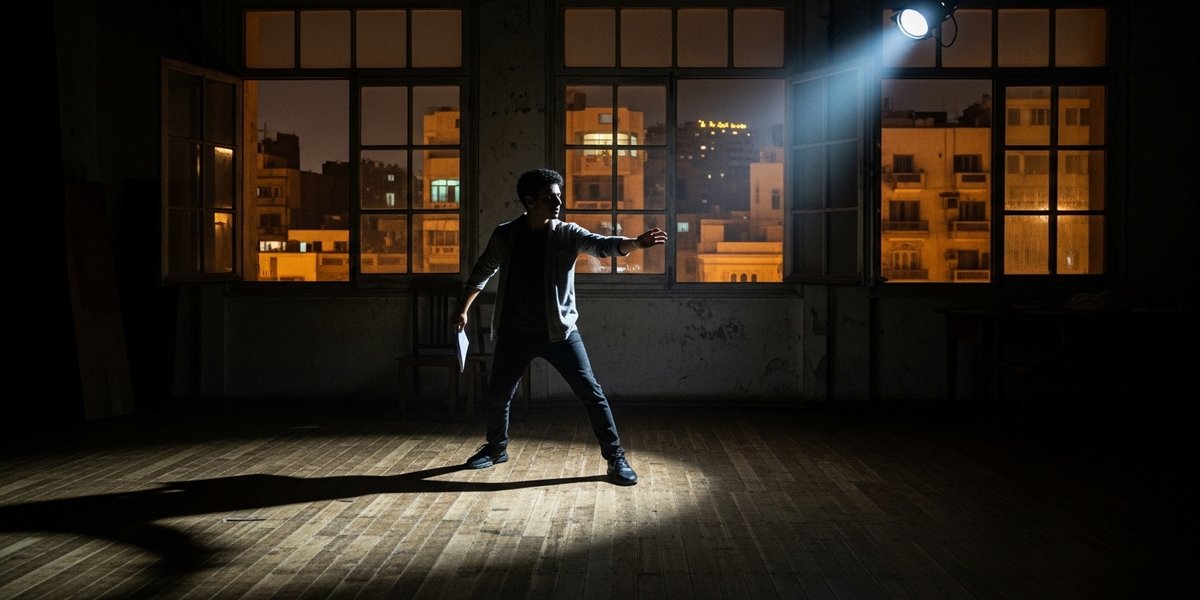
Ahmed El Attar makes theater that is difficult to categorize — which is precisely the point. As the founder of Temple Independent Theater Company in Cairo and the creator of the Downtown Contemporary Arts Festival (D-CAF), El Attar has spent two decades building infrastructure for contemporary art in a city whose century-long cinematic tradition overshadows its theater scene.
His productions — performed in Arabic, French, and English — move between Cairo, Paris, Brussels, and Berlin with an ease that belies the enormous effort required to make independent theater work across the Mediterranean divide. His plays, including On the Importance of Being an Arab and Mama, use minimalist staging to explore the fractures of Egyptian society with a subtlety that owes as much to Beckett as to Arabic theatrical tradition.
When EuroMed Café met El Attar, he was characteristically blunt about both the potential and the limitations of cultural dialogue.
EuroMed Café: You founded Temple Company in Cairo in 2000. What was the cultural landscape like at that time?
Ahmed El Attar: Empty. Or rather, full — but full of the wrong things. State theater in Egypt was producing nationalistic spectacles — while cinema, as Youssef Chahine showed, had already found its way to international audiences. Commercial theater was producing slapstick comedies. There was nothing in between — no space for experimentation, no space for work that asked uncomfortable questions about Egyptian society. Temple was created to fill that gap.
EMC: Your work moves between European and Arab audiences. Do they see the same play?
AEA: They see the same actions but read different meanings. When an Egyptian audience watches Mama — about a family trapped in a cycle of control and dependency — they see their own family, their own society, their own political system. When a European audience watches the same play, they see an exotic situation that confirms their assumptions about Arab patriarchy. Both readings are valid. But only one is complete.
EMC: What would complete the European reading?
AEA: Context. And honesty. Europeans need to understand that when they watch Arab art through the lens of “the Arab world has a problem,” they are seeing only their own projection. The problems in my plays — authority, conformity, the crushing weight of tradition — these are universal problems. France has them. Germany has them. But when a French playwright addresses them, it is called “universal theater.” When I address them, it is called “Arab theater.” This asymmetry is the real obstacle to dialogue.
EMC: What would genuine cultural dialogue look like?
AEA: It would start with collaboration, not presentation. Right now, Euro-Mediterranean cultural programs work like showcases: you bring an Arab artist to Europe, they perform, Europeans applaud, everyone goes home. That is not dialogue. Dialogue means making something together — writing a play together, building a festival together, failing together. The shared failure is more valuable than the polite applause.
Ahmed El Attar continues to direct Temple Company in Cairo and curate D-CAF, one of the most important contemporary arts festivals in the Arab world. His recent productions tour internationally, maintaining the cross-Mediterranean practice he has championed for over two decades.