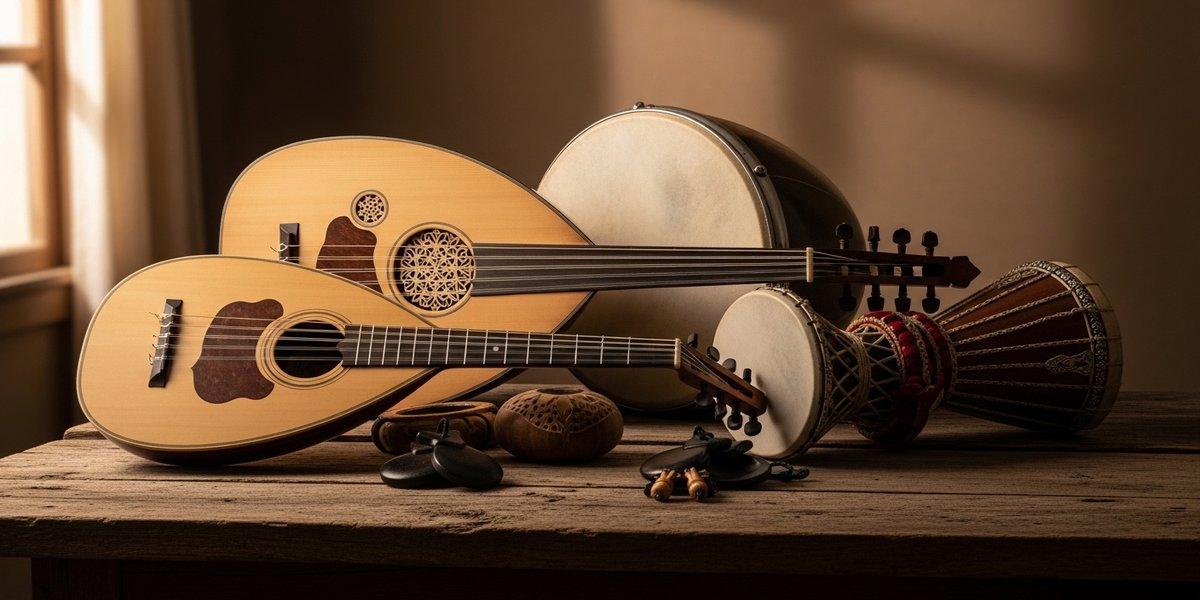
Every sea has a sound. The Atlantic roars. The Pacific hums. The Mediterranean murmurs — in Arabic, Greek, Spanish, Turkish, Italian, Portuguese — and the instruments that give voice to those murmurs are as diverse and interconnected as the cultures that play them. Here are six instruments that, together, tell the story of a sea and its civilizations.
The Oud
The grandfather of the European lute — the name itself derives from the Arabic al-ʿūd (the wood) — the oud has been the backbone of Arabic, Turkish, and Persian music for over a thousand years. Fretless, with eleven or thirteen strings, it produces a warm, resonant tone that is at once meditative and ornate. The oud crossed the Mediterranean during the Moorish period and spawned an entire family of European stringed instruments, from the Renaissance lute to the modern guitar. To hear an oud player improvise a taqasim — a solo introduction that establishes the maqam (mode) — is to hear the musical foundation on which the entire Mediterranean was built.
The Bouzouki
Greece’s most recognizable instrument arrived with the refugees from Asia Minor in the 1920s, carrying with it the microtonal intervals and improvisatory tradition of Ottoman music. In the hands of rebetiko musicians, the bouzouki became the voice of the urban dispossessed — sharp, metallic, defiant. Today it anchors both traditional rebetiko and contemporary Greek music, a bridge between the Ottoman past and the European present.
The Guitarra Portuguesa
The twelve-stringed pear-shaped guitar that gives fado its distinctive shimmer is an instrument of unusual beauty and unusual difficulty. Its origins are debated — some trace it to the Arabic cittern tradition, others to medieval European instruments — but its voice is unmistakable: bright, cascading, and freighted with the saudade that defines Portuguese music. In the hands of a master, the guitarra portuguesa sounds like weeping made musical.
The Cajón
The box drum that anchors modern flamenco has its roots not in Spain but in Peru, where enslaved Africans, denied access to drums by colonial authorities, turned shipping crates into percussion instruments. The cajón arrived in Spain in the 1970s through Paco de Lucía, who encountered it during a tour of Latin America and immediately recognized its potential for flamenco. It has since become as essential to the genre as the guitar and the voice.
The Guembri
The three-stringed bass lute of the Gnawa is an instrument designed to induce trance. Its deep, resonant thrum — produced by a body covered in camel skin — creates a vibrational field that is felt as much as heard. In the hands of a maâlem (master musician), the guembri drives the hours-long healing ceremonies in Essaouira that lie at the heart of Gnawa tradition.
The Qraqeb
Iron castanets, heavy and loud, played in pairs by Gnawa musicians to create the rhythmic scaffolding over which the guembri and voice operate. The sound is sharp, insistent, hypnotic — and it carries across Essaouira’s medina on festival nights like a metallic rain. The qraqeb are not merely accompaniment; they are the rhythmic engine that drives the ceremony forward toward its spiritual climax.
These six instruments — spanning three continents and two millennia — share a quality that is difficult to name but easy to hear: a tendency toward complexity, ornamentation, and emotional directness that sets Mediterranean music apart from both the harmonic traditions of Northern Europe and the rhythmic traditions of Sub-Saharan Africa. They are the tools with which the cultures of the inland sea have, for centuries, turned their particular experience of loss, beauty, and survival into sound.