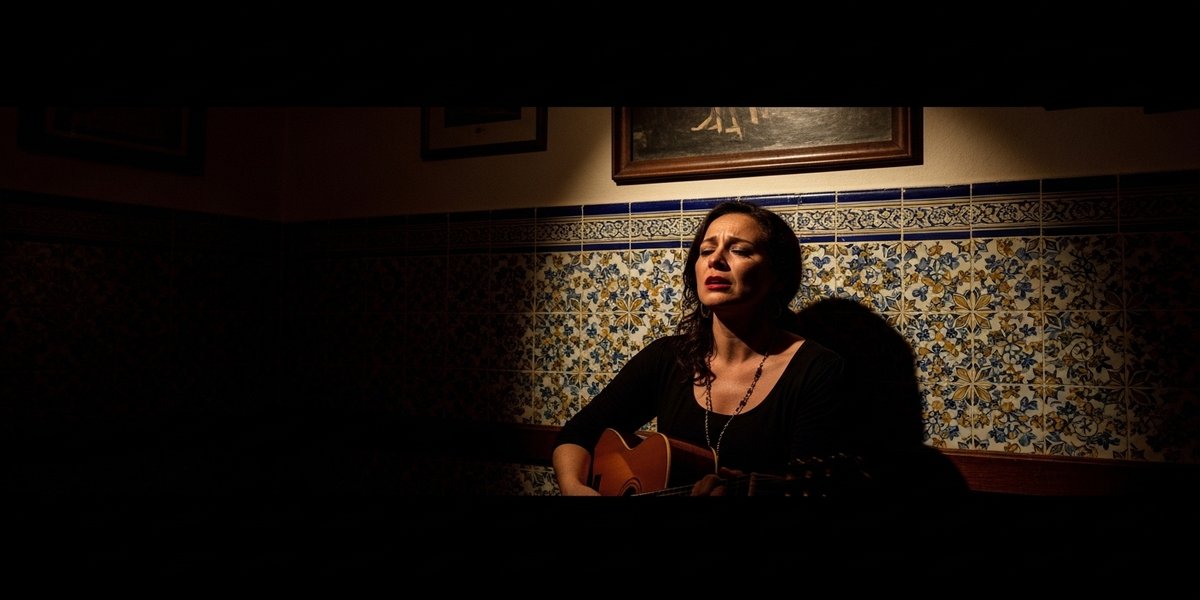
Fado means fate. The word itself — from the Latin fatum — carries the weight of inevitability that defines the genre: these are songs about what cannot be changed, about loves that were lost before they began, about a homeland that exists only in memory. If rebetiko is the blues of Greece and flamenco the blues of Spain, fado is Portugal’s contribution to the Mediterranean tradition of singing about everything that hurts.
Alfama and the Myth of Origin
The standard history places fado’s birth in the working-class neighborhoods of Lisbon — Alfama, Mouraria, Bairro Alto — in the early nineteenth century. The genre’s founding figure, Maria Severa (1820–1846), was a tavern singer and courtesan whose short life became the template for the fado myth: passion, poverty, and an early death that guaranteed immortality.
But this origin story, like most origin stories, is incomplete. Fado’s musical DNA contains traces of Brazilian modinha and lundum — genres that traveled to Portugal with returning colonists and enslaved Africans. The guitarra portuguesa, the twelve-stringed instrument that gives fado its distinctive shimmer, has ancestors in the Arabic oud and the medieval European cittern. Fado is not purely Portuguese; it is a Mediterranean synthesis, refined in Lisbon but rooted in a much wider geography.
Amália and After
Amália Rodrigues, who dominated fado from the 1940s until her death in 1999, turned the genre into a national symbol — and, in doing so, both preserved and constrained it. Under the Salazar dictatorship, fado was co-opted as a tool of national identity: the regime promoted an idealized version of Portuguese culture built on the three F’s — fado, Fátima, and football — while suppressing dissent.
The generation that followed Amália — Mariza, Ana Moura, Cristina Branco, Carminho — has worked to detach fado from its nationalist associations while honoring its emotional core. These singers bring fado into contact with jazz, world music, and contemporary composition, creating a living tradition that speaks to audiences far beyond Portugal.
The Mediterranean Connection
Fado’s resonance in the wider Mediterranean is not accidental. The concept of saudade — the untranslatable Portuguese word for a longing for something absent — has equivalents across the region: the Arabic haneen, the Turkish hüzün, the Greek nostos from which “nostalgia” derives. These cultures share a vocabulary of loss that finds its most concentrated expression in song.
To hear fado in a Lisbon tavern is to understand something essential about the Mediterranean relationship to time: the past is never past, loss is never resolved, and beauty — when it comes — arrives wrapped in sadness. This is not pessimism. It is realism, set to music.