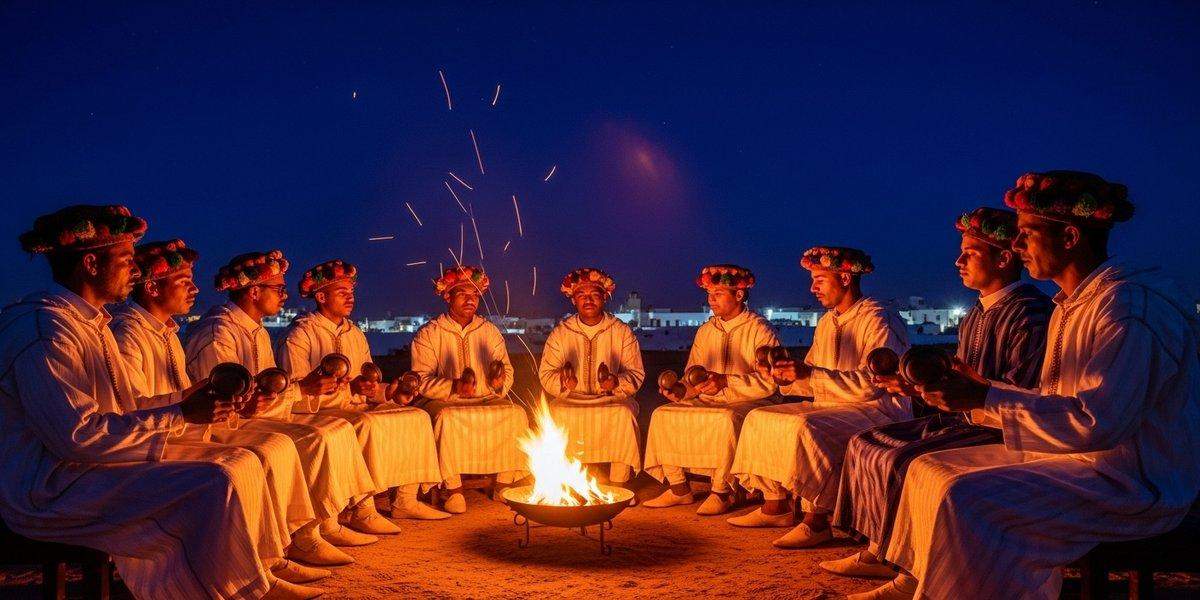
The sound begins after midnight. A single guembri — the three-stringed bass lute that is one of the instruments defining the Mediterranean sound — rumbles through the narrow streets of Essaouira like a heartbeat made audible. Iron qraqeb (castanets) establish a pattern that will not change for hours. And then the singing starts: deep, incantatory, calling on spirits whose names predate Islam in Morocco by centuries.
Gnawa music is, in its original context, a healing ritual — a lila (night ceremony) in which a master musician (maâlem) leads a gathering through a sequence of songs associated with specific spiritual entities. The music induces trance, and trance permits healing. It is the closest thing the Maghreb has to the blues — born of suffering (the gnawa are descendants of sub-Saharan enslaved peoples brought to Morocco), refined through centuries of practice, and infused with a spiritual dimension that elevates the personal into the universal.
The Essaouira Festival
Since 1998, the Gnaoua World Music Festival in Essaouira has brought this tradition into the global spotlight. Held each June in the whitewashed Atlantic port city that Jimi Hendrix once visited and Orson Welles used as a filming location, the festival pairs gnawa masters with international musicians — jazz saxophonists, Malian kora players, Indian tabla virtuosos, electronic producers — in collaborations that test the limits of both traditions.
The results are uneven — as any honest fusion must be — but at their best, these collaborations reveal the deep structural affinities between gnawa and other trance-based musical traditions. The circular rhythms of gnawa, the call-and-response vocal patterns, the gradual intensification that builds over hours rather than minutes: these are the same principles that drive West African drumming, Indian raga, and, in a secularized form, the repetitive structures of electronic dance music. The cross-Mediterranean dialogue between gnawa and flamenco makes this kinship audible.
Beyond the Festival
The festival has been criticized — fairly — for commodifying a sacred tradition. When gnawa is performed on a stage for a paying international audience, something essential is lost: the intimacy of the lila, the spiritual purpose of the music, the relationship between the maâlem and the community he serves. But the festival has also created economic opportunities for gnawa musicians, international recognition for a tradition that was marginalized within Morocco itself, and a platform for cross-cultural musical dialogue that would not otherwise exist.
The tension between preservation and exposure, between sacred and commercial, is one that every traditional music form faces in the twenty-first century. Gnawa’s response — to engage with the global music industry on its own terms, without abandoning the spiritual core of the tradition — offers a model that other Mediterranean musical forms would do well to study.